
When to Switch from Coworking to Managed Office
⚡ QUICK ANSWER
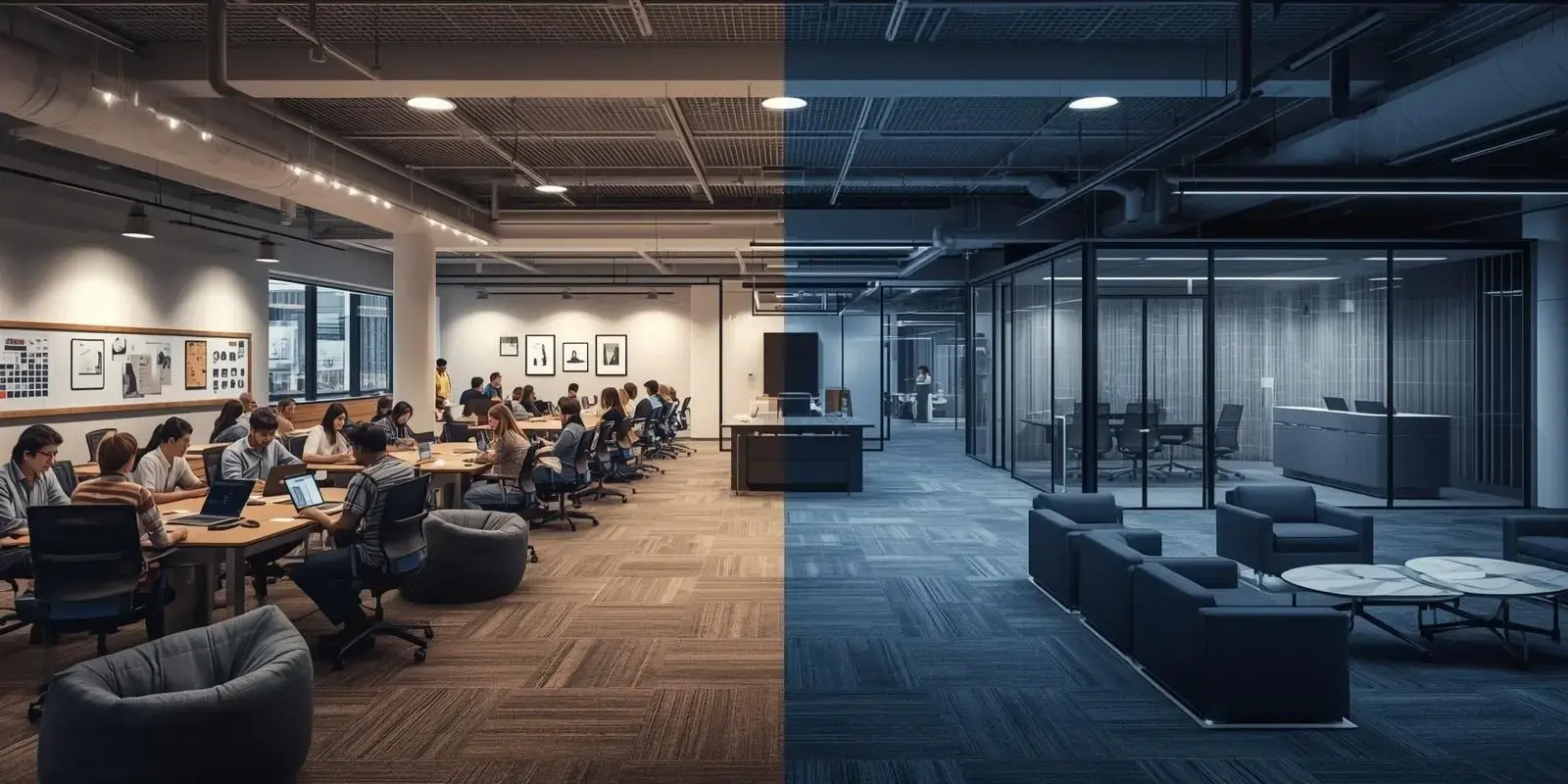
Switch from coworking to a managed office when your team exceeds 25–30 people, you need private infrastructure for client calls or data security, your brand requires its own identity in the workspace, or compliance requirements (STPI, SOC 2, ISO readiness) cannot be met in a shared environment. The transition tipping point is typically when coworking friction costs — noise disruptions, meeting room conflicts, security gaps, and brand dilution — exceed the cost premium of a dedicated managed office.
Coworking Is Great — Until It Isn’t
Coworking spaces serve a vital purpose. They are the launchpad for thousands of companies — providing affordable, flexible, move-in-ready workspace that removes operational friction when you are focused on building a product, hiring your first team, or validating a market. For teams of 1 to 20 people, choosing from the top 10 coworking spaces in Coimbatore is often the smartest workspace decision you can make.
But coworking was designed for a specific stage of business. The open floor plans, shared meeting rooms, communal pantries, and rotating neighbours that feel energising at 8 people become operationally limiting at 30. This is often the point where founders realize that coworking space limitations for a growing company start impacting the bottom line through lost productivity. The casual environment that attracted you as a startup begins to undermine your credibility when you are hosting enterprise clients. The “flexibility” of month-to-month terms starts feeling like instability when you are trying to plan headcount 12 months ahead.
The challenge is that the transition point is not always obvious. Most companies stay in coworking 6–12 months longer than they should because the switching cost feels high and the pain accumulates gradually. This article identifies the specific warning signs that indicate you have outgrown coworking, provides a structured comparison framework, and outlines how to execute the transition without operational disruption.
8 Warning Signs You’ve Outgrown Coworking
If three or more of these signs describe your current situation, you are likely past the coworking tipping point.
Your Team Exceeds 25–30 People
At this size, you occupy a significant portion of the coworking floor but do not control it. You are paying per-seat coworking rates for a team that could fill a private floor at managed office rates — which are often equal or lower per seat at this volume. More importantly, managing 30 people across hot desks or cluster seating in a shared environment creates coordination overhead that a dedicated office eliminates.
Client Meetings Feel Unprofessional
Your clients arrive and walk through someone else’s reception. They sit in a meeting room that another company was using five minutes ago, with a whiteboard still showing a stranger’s strategy diagram. The coffee area has a ping-pong table and beanbags. For B2B enterprise sales, investor meetings, or client governance reviews, the coworking environment signals “startup” when you need to signal “established.” A dedicated managed office with your branding at reception immediately shifts that perception.
You’re Losing Meeting Rooms to Other Tenants
Shared meeting rooms are the most common friction point in coworking spaces. If your team regularly cannot book rooms when needed, if calls get bumped because the previous occupant ran over, or if you find yourself taking client calls from the pantry, the shared infrastructure is no longer serving your operational needs. A managed office with dedicated meeting rooms that only your team uses eliminates this problem entirely.
Data Security and Privacy Are Becoming Concerns
As your business matures, so do your compliance requirements. Shared Wi-Fi networks, open floor plans where screens are visible to anyone walking past, and communal printers where documents sit in shared trays create genuine data security risks. If you handle client data, financial information, healthcare records, or proprietary IP, or if your clients require SOC 2, ISO 27001, or GDPR readiness, the shared coworking environment is structurally incompatible with these requirements.
Your Culture Is Getting Diluted
When your team of 30 shares space with five other companies, your workplace culture competes with five other cultures. Noise levels, work styles, social norms, and even working hours are influenced by people who do not share your company’s values or standards. A dedicated office creates a controlled cultural environment where your team operates by your norms, your energy, and your standards — which directly impacts productivity, retention, and team cohesion.
You Need STPI Registration or Statutory Compliance
For IT/ITeS companies requiring STPI (Software Technology Parks of India) registration, specific workspace compliance requirements must be met: dedicated premises, defined boundaries, proper IT infrastructure documentation, and in many cases, physical separation from other entities. Coworking spaces rarely meet STPI compliance requirements. The same applies to PF/ESI establishment codes tied to specific registered premises. If compliance is becoming a checkbox you cannot tick in coworking, it is time to move.
Your Per-Seat Cost No Longer Makes Sense
At 1–10 seats, coworking provides shared infrastructure at a fraction of what it would cost to set up independently. At 30+ seats, the economics invert. You are paying premium per-seat rates for shared resources while the per-seat cost of a dedicated managed office with private infrastructure often comes in equal or lower. Run the numbers: if your current coworking cost for 30+ seats exceeds ₹5,500–6,000 per seat per month, a managed office in Coimbatore at ₹4,000–6,500 per seat gives you more for the same or less.
You Are Planning to Hire Aggressively in the Next 6–12 Months
Coworking spaces handle growth in increments — one seat here, three seats there. This works for organic, slow growth. If your hiring plan calls for adding 20–50+ people in the next two quarters, coworking cannot guarantee adjacent seating, consistent infrastructure, or the ability to house your entire team in one cohesive workspace. A managed office provider with enterprise capacity can deploy 50–100 seats in a single setup, ensuring your entire team operates together from Day 1 of the hiring ramp.
Coworking vs Managed Office: The Full Comparison
This comparison examines the two models across the dimensions that matter most for growing businesses evaluating the transition
| Dimension | Coworking Space | Managed Office (EaaS) |
|---|---|---|
| Ideal team size | 1–25 people | 25–500+ people |
| Workspace type | Shared floor, hot/dedicated desks | Private dedicated floor |
| Branding | None — provider’s brand visible | Full client branding (reception, signage, glass film) |
| Meeting rooms | Shared — booking conflicts common | Dedicated — exclusively yours |
| Privacy | Open environment, visible screens, shared networks | Private floor, dedicated network, access-controlled |
| Security | Building-level access shared with all tenants | Floor-level biometric/card access, tenant-specific CCTV |
| Compliance (STPI/SOC 2) | Rarely compliant — shared premises | STPI-ready, supports SOC 2/ISO readiness |
| IT infrastructure | Shared Wi-Fi, basic networking | Dedicated LAN, enterprise Wi-Fi, server room, UPS |
| CAPEX requirement | Zero | Zero (EaaS model) |
| Contract flexibility | Month-to-month or 6–12 months | 24-month minimum |
| Per-seat cost (CBE) | ₹3,000–8,000 (varies widely) | ₹4,000–6,500 (enterprise all-inclusive) |
| SLA framework | Not typical | Written SLAs with service credits |
| Facility manager | Community manager (shared across all tenants) | Dedicated facility manager (single point of contact) |
| Setup speed | Same day (move-in ready) | 7 days (EaaS deployment) |
| Culture control | Shared with other tenants | 100% your team, your standards |
The Transition: How to Move Without Disruption
The biggest fear with switching workspaces is operational disruption — downtime, lost productivity, employee confusion. Here is a practical transition framework that minimises disruption.
Step 1: Run the Numbers (Week 1)
Calculate your current total coworking cost: per-seat rate × seats + any add-on meeting room charges + any premium for private cabins + parking. Compare this against managed office quotes for the same seat count. In Coimbatore, you will often find that a 30+ seat managed office costs the same or less per seat than coworking, while giving you significantly more — private floor, dedicated meeting rooms, branded reception, enterprise IT infrastructure.
Step 2: Define Your Requirements (Week 1–2)
Before approaching managed office providers, document your needs: exact seat count with 6-month growth buffer, number of meeting rooms required, IT specifications (bandwidth, VPN, server room), compliance requirements (STPI, SOC 2), branding requirements, and operational hours. This ensures proposals are accurate and comparable.
Step 3: Tour and Evaluate (Week 2–3)
Visit at least 2–3 enterprise managed office Coimbatore providers. Walk the actual floors you would occupy. Test the internet. Check the meeting rooms. Ask about the SLA framework. Meet the facility manager who would be your day-to-day contact. The difference between a coworking floor and a dedicated enterprise floor is immediately apparent in person when evaluating a plug and play office Coimbatore.
Step 4: Negotiate and Sign (Week 3–4)
Enterprise managed office agreements are negotiable. Key negotiation points: per-seat rate (volume discounts for 50+ seats), security deposit structure, SLA service credits, deployment timeline guarantees, scalability terms (adding seats later), and exit clauses. Do not accept the first quote — this is an enterprise procurement process, not a consumer transaction.
Step 5: Deploy and Move (Week 4–5)
With an EaaS provider like Innovspace, deployment takes 7 days from signing. Overlap your coworking notice period with the managed office deployment period to ensure zero downtime. Move teams in phases if preferred — leadership and core functions first, then remaining teams. Most coworking providers require 30 days notice, which gives you ample time to execute the transition.
Decision Framework: Stay or Switch?
Use this simple diagnostic to make the decision:
| Question | Stay | Switch |
|---|---|---|
| Is your team under 20 people with no near-term growth plans? | ✓ Stay | |
| Do you host enterprise clients or investors regularly? | ✓ Switch | |
| Do you handle sensitive data requiring network separation? | ✓ Switch | |
| Do you need STPI registration or SOC 2/ISO compliance? | ✓ Switch | |
| Are you hiring 20+ people in the next 6 months? | ✓ Switch | |
| Is your per-seat coworking cost above ₹5,500/mo at 30+ seats? | ✓ Switch | |
| Do meeting room conflicts disrupt your team more than twice a week? | ✓ Switch | |
| Do you value month-to-month flexibility over operational stability? | ✓ Stay | |
| Does your team culture get diluted by the shared environment? | ✓ Switch | |
| Is your team under 10 people and primarily remote-first? | ✓ Stay |
Scoring: If you marked 4 or more “Switch” answers, the data points toward a managed office transition. If you marked 3 or more “Stay” answers, coworking is likely still the right fit — revisit this diagnostic in 6 months as your situation evolves.
FAQs: Switching from Coworking to Managed Office
Ready to Make the Switch?
If you scored 4 or more warning signs, or if the decision framework pointed toward “Switch,” the next step is a conversation — not a commitment. Innovspace offers no-obligation managed office consultations where we assess your seat count, requirements, and timeline, and provide a customized proposal within 48 hours.
- Category:
- Workspace Strategy,
- Enterprise Growth,
- Coimbatore
