
GCC Operating Models Explained: Captive, BOT, Virtual Captive and GCC-as-a-Service
⚡ THE SHORT ANSWER
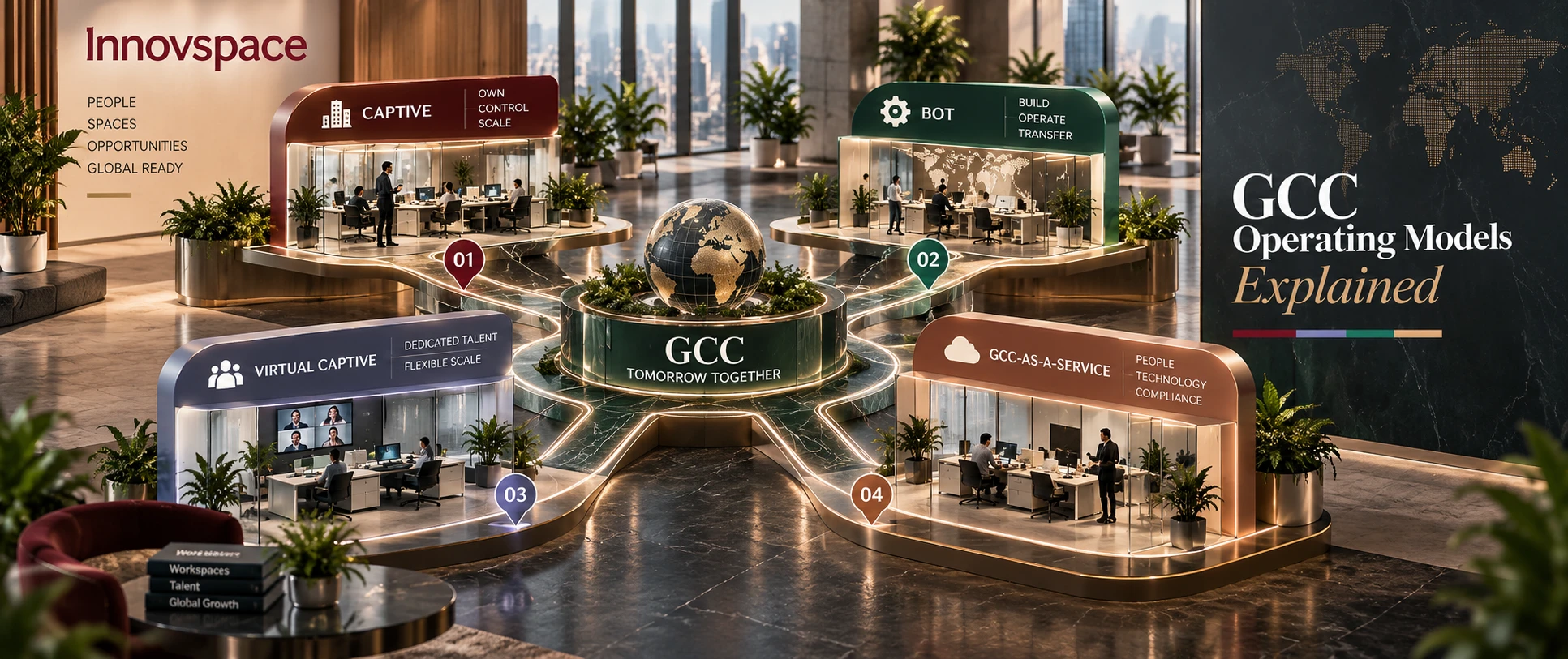
Four models. A captive is wholly yours — your entity, your staff, your lease, full control, slowest to stand up. BOT means a partner builds and runs it, then transfers it to you after two or three years. A virtual captive puts the team on a vendor’s payroll while working exclusively for you — no Indian entity needed. GCC-as-a-Service bundles entity, hiring, payroll, compliance and workspace into one subscription.
The rule of thumb: the more control you want, the longer it takes and the more you carry upfront. Most companies setting up in Coimbatore choose captive, because they intend to keep the centre.
Before a company chooses a city for its India centre, it has to answer a harder question: who actually owns and runs it? That decision — the operating model — determines your cost base, your control, your speed to first hire, and how much of the risk sits on your balance sheet rather than someone else’s.
There are four models in common use. Most coverage explains them from a consulting perspective, which is useful right up to the point where you have to put people in a building. This guide covers what each model is, who it suits, and the part almost nobody writes about — what your choice of model means for the office you will need.
In this article
1. What a GCC Operating Model Actually Decides
A Global Capability Centre is a company’s own offshore team, doing work the company would otherwise do at head office or buy from a vendor — engineering, finance, analytics, support, R&D. The operating model is the legal and commercial structure underneath it.
Four things follow from that choice, and all four are hard to reverse cheaply:
- ✓Who employs the people. Your Indian entity, or someone else’s.
- ✓Who carries the risk. Setup cost, hiring mistakes, compliance failures, and the cost of winding down if the plan changes.
- ✓How fast you can start. Registering an entity and hiring 150 people takes months. Renting a team does not.
- ✓What you own at the end. A captive is an asset on your balance sheet. A vendor arrangement is a contract you can cancel.
2. The Four Models, Defined
Captive — a wholly owned subsidiary
You register an Indian company, hire your own employees, sign your own agreements and run the centre yourself. It is a subsidiary of the parent in every sense: your brand on the door, your policies, your systems, your P&L.
This is the traditional model and still the most common for centres intended to last. It gives complete control over hiring standards, IP, data handling and culture. It also means you carry every cost and every risk from day one, and you cannot start hiring until the entity exists.
BOT — Build, Operate, Transfer
A partner sets the centre up, runs it for an agreed period — usually two to three years — and then transfers the whole thing to you. The entity, the employees, the systems and the workspace all move across at the end.
The appeal is speed without commitment. The partner already knows how to register entities, navigate labour law and recruit locally, so you reach first-hire faster than you would alone. If the business case changes before transfer, you exit having spent far less than a failed captive would have cost. The trade-off is that you are paying a margin for that, and you are running your India strategy through someone else’s judgement during the years that set its culture.
Virtual captive — your team, their payroll
A vendor employs the people, but they work exclusively for you, to your direction, often in space branded for you. No Indian entity is required. To your team in Coimbatore it can feel indistinguishable from a captive; legally it is a service contract.
It suits companies that want dedicated capacity without a legal footprint in India — either because the volume does not justify an entity, or because the parent is not ready to commit. The limit is that the people are not yours. If the vendor relationship ends, so does the team, and the institutional knowledge goes with it.
GCC-as-a-Service — the whole stack, as a subscription
The newest of the four. A provider supplies everything — entity or entity-equivalent, recruitment, payroll, compliance, IT and workspace — as a single monthly arrangement. You direct the work; they run the machinery.
It is the fastest route to an operating team and the lightest commitment. It is also the least control, the highest per-head cost at scale, and the model in which you accumulate the least that is durably yours.
3. Control, Speed and Risk — The Real Trade-Off
Every model trades the same three things against each other. There is no model that maximises all three.
| Captive | BOT | Virtual captive | GCC-as-a-Service | |
|---|---|---|---|---|
| Who employs the team | You | Partner, then you | Vendor | Provider |
| Indian entity needed | Yes | Eventually | No | No |
| Time to first hire | Slowest | Faster | Fast | Fastest |
| Control over hiring and culture | Complete | Shared, then complete | Limited | Least |
| Upfront cost and risk | Highest, on you | Shared | Low | Lowest |
| What you own at the end | An operating subsidiary | An operating subsidiary | A contract | A contract |
| Cost per head at scale | Lowest | Medium | Medium | Highest |
India now hosts well over 1,800 GCCs and the segment continues to expand into cities beyond the traditional metros. Sector data is tracked by NASSCOM’s Global Capability Centres community, which publishes the GCC Annual Report and the Technology Sector in India Strategic Review.
4. Which Model Suits Which Company
The honest version of this is not a scoring matrix. It is a small number of questions whose answers point fairly clearly in one direction.
| If this is true of you | The model that usually fits |
|---|---|
| The centre is strategic and you expect it to outlive the current leadership | Captive |
| You are certain about the destination but not about your ability to build there | BOT |
| You need 20–60 people and an Indian entity is disproportionate | Virtual captive |
| You need to be operating this quarter and will decide the structure later | GCC-as-a-Service |
| Your work involves regulated data, or the parent must certify controls | Captive, usually — the audit trail is simpler when the entity is yours |
| This is a pilot with a genuine chance of being shut down | Anything but captive |
Two observations from the market rather than from theory. First, the models are not permanent — a great many centres begin as virtual captives or BOT arrangements and convert once headcount and confidence justify it. Second, size is the strongest single predictor: below roughly 50 people the entity overhead rarely pays for itself, and above roughly 200 it almost always does.
5. What Your Model Means for Your Workspace Decision
This is the part most GCC content skips, and it is the part that becomes urgent about four weeks before anyone actually sits down.
If you are building a captive
You will need your own floor. Not desks in a shared room — a defined, access-controlled space you can brand, lay out to your own density, and hand to an auditor. Most parent companies will expect network isolation, biometric control at the floor boundary, and documented physical security before they sign off.
That points at a managed office or a dedicated enterprise floor rather than a coworking arrangement. It also means the workspace decision arrives earlier than people expect — you cannot complete entity registration and then start looking, because the fit-out timeline will overrun your hiring plan. We have written separately on what an enterprise office includes and how it differs from coworking, and on standing up a 100-seat office quickly.
If you are doing BOT
One question is worth asking at the contracting stage rather than in year three: what happens to the space at transfer?
Everything else in a BOT is designed to move — the entity, the employees, the systems. Premises are the item most likely to complicate that, because a commercial lease signed in the partner’s name is a contract between the partner and a landlord, and you are not a party to it. Moving it to your name generally needs the landlord’s agreement, which they are under no obligation to give on the terms you would like.
If you are running a virtual captive or GCC-as-a-Service
In most cases your vendor or provider supplies the space and this is not your decision to make. Say so to your own team early, because people often assume otherwise and plan around an office that was never in scope.
The exception worth knowing about: some companies on these models still want their people in a space that carries their brand and meets their security standards, even though the payroll sits elsewhere. That is arrangeable, but it needs to be specified in the vendor contract — it will not happen by default.
6. Where Each Model Goes Wrong
Each model has a characteristic failure, and they are predictable enough to plan around.
| Model | How it typically fails |
|---|---|
| Captive | The business case assumed a ramp that hiring could not deliver, and a half-full floor is carried for three years. Or the parent underestimated how much management attention an owned subsidiary consumes. |
| BOT | The transfer is agreed in principle and then stalls on the details — premises, key employees' contracts, systems licences. Two years of goodwill is spent negotiating what should have been settled at the start. |
| Virtual captive | The team becomes genuinely valuable, the company decides to bring it in-house, and discovers the vendor's contract makes that expensive or slow. Or the vendor loses the people and the knowledge leaves with them. |
| GCC-as-a-Service | It works, headcount grows, and the per-head economics quietly become the worst of the four. Nobody revisits the model because it is not broken — just increasingly expensive. |
If Coimbatore is on your shortlist, our companion piece sets out why the city is drawing GCC investment — cost, talent supply, attrition and state policy. For the practical side of registering and standing up an entity here, see our guide to setting up an IT company in Coimbatore, and for where enterprise floors actually sit, the Kalapatti IT corridor overview.
7. Frequently Asked Questions
Choosing a Model, and Then a Floor
Innovspace operates enterprise managed office space in Coimbatore across two campuses — Aero Zone at SITRA and Edge Zone at Kalapatti — for teams of 50 to 500 or more. Zero capex, and operational within 30 days of agreement.
If you have settled on a captive or are working through a BOT, tell us your seat count and your target date and we will tell you what is available and what handover looks like. If you are on a virtual captive or a managed service, your provider may already be covering this — we will say so rather than sell you something you do not need.
Talk to Our Enterprise Team- Category tags:
- GCC Operating Models,
- Captive GCC,
- BOT Model,
- Enterprise Office
